
Last Updated on October 16, 2025 by Nadim Alamuddin
Artificial Intelligence (AI) is everywhere: in our meetings, on our timelines, in every boardroom conversation. We cannot seem to do anything without a reference to it, either at work, on social media, or on the news. With AI comes many advantages, including process efficiency, improved user experience, revenue growth, etc. And while a lot of companies are starting to adopt AI into their processes, there have been quite a number of AI Challenges at the workplace.
Before jumping into the challenges, a note to say that this blog post topic deviates from what I usually write about. But, since AI is upon us, I have created a new category for AI Transformation & Tools, so I can write more posts on this evolving topic.
Here are five real-world challenges I’ve seen across industries, and how you can overcome them.
Table of Contents
Challenge 1: I want AI, but I have no idea where to start!
With so many AI tools and applications coming up on a daily basis, how can people focus on what they actually need? In the last couple of years, while I have been implementing digital transformation projects, I started talking to different clients and colleagues about this topic. There is an overall fascination with what AI offers, its potential, how it can make your life easier, but there’s also a subtle unease when you start asking them how they’re using AI, if at all.
In essence, what usually happens is that, without a clear starting point grounded in business value, organizations stay in planning mode. I like to call this group the Explorers, those curious about AI, eager to learn, but unsure how to turn interest into action.

Challenge 2: While Pilots May Succeed, They Stay On The Ground…
Some organizations do succeed in starting pilot projects with AI tools or apps. In my opinion, these are the experimenters. But why do these pilots never take off? One key reason: they often lack alignment with the business strategy or leadership buy-in. Without executive sponsorship, even the most promising pilot will not take off the ground.
For a pilot project to successfully be scaled to other departments or to the organization as a whole, it would need approval, proper funding, governance, change management. These processes cannot be done in isolation.
Challenge 3: Leaders May Talk Strategy, But AI Is Not On The Roadmap
In the boardroom and in meetings, executives may discuss AI’s importance, but if it’s not already embedded in the organization’s strategic priorities or investment roadmap, the teams reporting to these executives may not get the approval to get these AI pilots acted upon. It’s like launching a product with no market plan (effort without direction).
The result here is that, while middle management may be trying a few pilots and succeed, the executives will try to distance themselves, as they know it’s not going to fly as long as AI is not on the roadmap.
Challenge 4: The Basic Foundations Are Not There
In a lot of previous implementation projects, I have experienced this challenge first-hand. As a consulting company, we come to implement a complex ERP, only to find out the client does not have the right infrastructure to sustain the increased volume of users, transactions and reports required from the systems. This always lends to unplanned delays and risks to the implementation.
Similar challenges apply with Artificial Intelligence (AI). If the infrastructure is weak as a foundation, it needs to be strengthened before you start implementing AI tools, models & applications. Similarly, if you have poor, inconsistent, inaccurate or unstructured data, you’ll quickly find yourself building on sand as you start implementing AI, as it strongly relies on good data for its tools and models.
Challenge 5: People Are Afraid, But No One Talks About It
What is the number one fear for employees? Job security. No matter what, whenever there’s change, people fear the worst. Will AI replace my job? Can I trust it? How do I know it is fair? What happens if it makes a mistake?
These questions exist in every company. Alas, they’re often unspoken. Teams feel unsure, but no one wants to seem resistant. So they nod politely in meetings and quietly disengage. Unfortunately, these unaddressed fears become hidden blockers. And there goes your AI adoption.
As a leader, you must create a safe space for your employees, to provide clarity, explanation. Most often, some roles will change and transform, rather than disappear. In addition to communications, you must invest in training and upskilling your employees, to prepare them to adopt and properly use the AI tools & apps. This is how you would avoid employee resistance to AI tools.

Bringing It All Together: AI As A Real Transformation
Do any of the above challenges sound familiar? I’m sure you’ve experienced some of them or others I may have not covered here. But, here’s the good news: each one of these challenges is solvable.
The key is to stop treating AI as a technology upgrade, and start looking at it as a business transformation. This means:
- Having a clear value driven roadmap
- Building foundational capabilities first
- Aligning leadership and change agents
- Investing in people as much as AI tools / apps
- Embracing governance and ethics from day one
Based on my experience implementing business and digital transformations, I’ve recognized similarities with AI, in that it is a transformation undertaking into the workplace. You do need a structured method to approach how to explore AI tools & apps, experiment with them, scale them into departments, and ultimately embed them in your organizational culture. This is why I created a step-by-step AI transformation playbook, to help organizations embed AI into their culture, capabilities, and strategy from day one.
If you’re serious about bringing AI into the heart of your organization, I invite you to check it out.
A Step-By-Step Guide To Embedding AI Into Your Corporate DNA
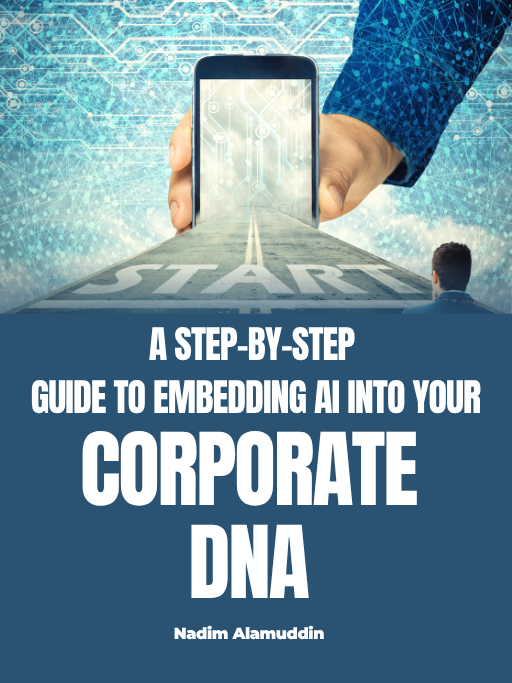
Note: For a Kindle version of the book, you can grab a copy here.
Thank you for reading this post. As I mentioned at the start of the post, this is the first time I write anything about AI, but I have a feeling that I will write more on this topic in the future. As such, for now, I cannot refer you to any similar posts, but will suggest more business oriented posts below:
- Use These Strategies To Be Perceived An Effective Leader
- How To Set Smart Goals And Achieve Them
- Top 13 Reasons Why People Reject Opportunity
If you happen to read my e-book, I’d love to hear your feedback!
Please do not forget to SHARE and like the post!
If you’re on Pinterest, please PIN the image below onto your favorite boards!